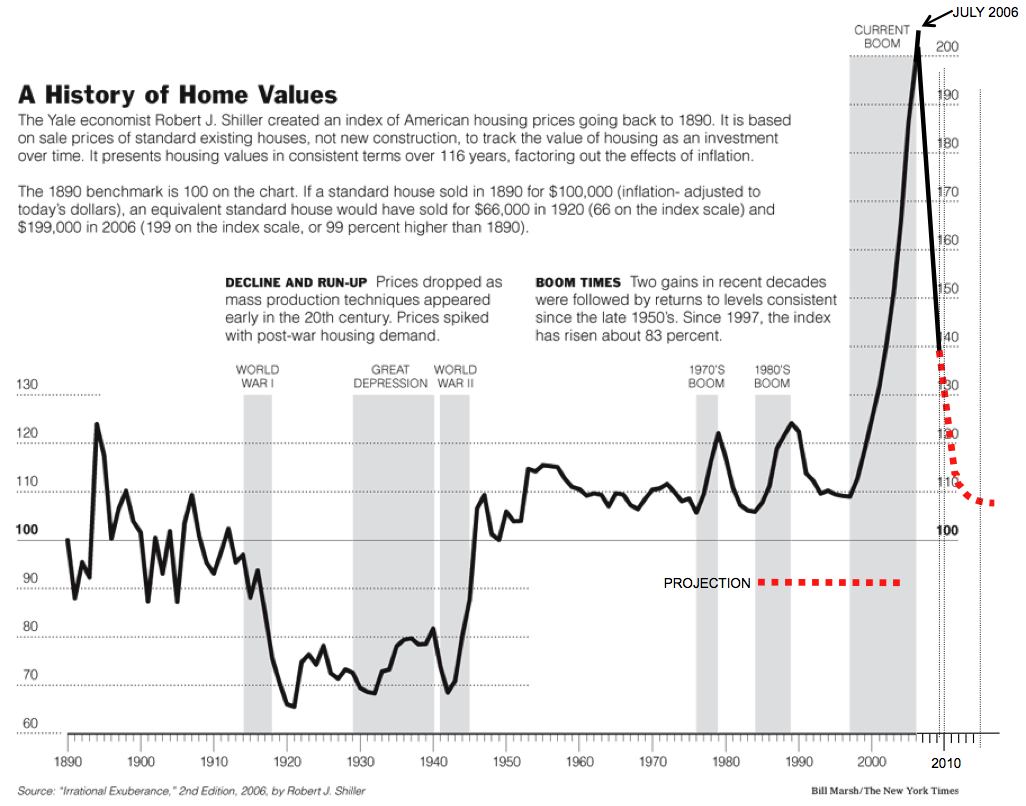
I came across this chart from Barry Ritzholt's site, The Big Picture , which had 100 year housing data, adjusted for inflation.
Referencing to the steady-state index value of 110, we still have about a 25% drop in average house price before we reach a steady-state value.
What's clear is that over the last 60 years, housing value grows only with inflation. In other words, it's not a sound investment, unless the goal is to turn a house / condo into a revenue-generating asset (eg a rental unit). Housing is a poor long-term investment strategy.
There are better long-term buy-and-hold strategies, the most consistent for the average person simply being an index fund (to be explored in the next post).
Saturday, January 2, 2010
Monday, December 28, 2009
The whys of statistics
In the US, are you really more likely to die from a lightning strike than die in a terrorist attack?
According to fivethirtyeight, you are 20 times more likely to be struck by lightning than fly on a plane where a terrorist attacks. Let's assume for a moment that his calculations are correct.
I think people should redirect some focus from the numbers themselves to the whys. While I think the US anti-terror effort (eg Homeland Security, TSA, etc) have been very ineffective and inefficient, the sheer effort (manpower / $) thrown at the problem has reduced the terrorist threat. In other words, the stats would not be the same if "business as usual" was standard procedure. However, the "Hows" of the achievement remains murky, and lead to concerns that acting in "business as usual" mode would have yielded the same statistics.
Two things I also would like to know:
1) Has analysis been done on program effectiveness? (Sadly, I think our government agencies lack the competence to do it, nor will they allow themselves to be subject to outside scrutiny)
2) TSA is now a behemoth organization whos edicts are not subject to question. Given this, why isn't there more outcry on the uniformly low standards placed on TSA employees? Can you imagine if FBI / CIA field agents were of the caliber of your average airport screener?
According to fivethirtyeight, you are 20 times more likely to be struck by lightning than fly on a plane where a terrorist attacks. Let's assume for a moment that his calculations are correct.
I think people should redirect some focus from the numbers themselves to the whys. While I think the US anti-terror effort (eg Homeland Security, TSA, etc) have been very ineffective and inefficient, the sheer effort (manpower / $) thrown at the problem has reduced the terrorist threat. In other words, the stats would not be the same if "business as usual" was standard procedure. However, the "Hows" of the achievement remains murky, and lead to concerns that acting in "business as usual" mode would have yielded the same statistics.
Two things I also would like to know:
1) Has analysis been done on program effectiveness? (Sadly, I think our government agencies lack the competence to do it, nor will they allow themselves to be subject to outside scrutiny)
2) TSA is now a behemoth organization whos edicts are not subject to question. Given this, why isn't there more outcry on the uniformly low standards placed on TSA employees? Can you imagine if FBI / CIA field agents were of the caliber of your average airport screener?
Sunday, December 27, 2009
The Official Tiger Woods Cocktail
1 part sake
1 part Godiva liquor
serve on the rocks with powdered sugar on the rim
a lemon wedge
Comment!
1 part Godiva liquor
serve on the rocks with powdered sugar on the rim
a lemon wedge
Comment!
Saturday, December 26, 2009
the iSlate?
Techcrunch article on the iSlate, Apple's rumored tablet PC:
http://www.techcrunch.com/2009/12/25/apple-islate/
Subscribe to:
Posts (Atom)